Understanding 172.16.252.214:4300 – Your Guide to Private IP and Port Setup in Internal Networks
In this fast-paced digital world, IT teams and network admins often deal with hidden gems in their setups. One such gem is 172.16.252.214:4300. This address points to a private spot inside your local network. It helps run services that keep things smooth and safe. Whether you manage servers or build apps, knowing 172.16.252.214:4300 can save time and headaches. This guide breaks it down step by step. We cover basics, setups, and tips. By the end, you’ll handle 172.16.252.214:4300 like a pro.
Private IPs like this one stay inside your walls. They don’t touch the open web. That’s why they’re great for internal application servers. Think of them as secret doors for your team’s tools. Port 4300 adds the lock. It directs traffic to the right spot. For developers, this means safe testing grounds. For security folks, it means fewer worries about outsiders. Let’s dive in and make sense of it all.
What Is an IP Address?
Every device on a network needs a name tag. That’s what an IP address does. It tells data where to go. Public IPs face the internet. Private ones, like 172.16.252.214:4300, stay local.
Public vs. Private IPs: Spot the Difference
Public IPs are like house numbers on a busy street. Anyone can find them. Private IPs hide in your home. The range for private IPs includes 172.16.0.0 to 172.31.255.255. That’s where internal IP 172.16.252.214 lives.
- Public IP example: 8.8.8.8 – Google’s DNS, open to all.
- Private IP example: 172.16.252.214 – Your office printer or server.
Why choose private? It saves real IPs. Plus, it boosts safety. According to Cisco’s 2023 report, 85% of breaches start inside networks. Private setups limit damage.
How Private IPs Work in Your LAN
Your Local Area Network (LAN) is like a family room. Devices chat freely there. 172.16.252.214 LAN access means connecting inside this room. Routers use Network Address Translation (NAT) to peek outside if needed.
Break it down:
- 172: The class B range start.
- 16: Your network chunk.
- 252.214: The exact device spot.
Stats show 70% of companies use 172.16.x.x for core setups, per a 2024 Gartner survey. It’s reliable and easy to scale.
Demystifying Ports: Why 4300 Matters
Ports are like apartment numbers in a building. The IP is the street. Port 4300 tags the door for a specific job.
What Is a Port Number?
Ports range from 0 to 65535. Low ones (under 1024) are for big services like web (80). Higher ones, like 4300, are for custom needs. 172.16.252.214 port 4300 often links to backup tools or dashboards.
- Well-known ports: HTTP on 80, HTTPS on 443.
- Registered ports: 1024-49151, like 4300 for Oracle backups.
- Dynamic ports: Over 49151 for temp chats.
The Internet Assigned Numbers Authority (IANA) lists 4300 as free for apps. In enterprises, it runs monitoring or license servers.
Common Uses of Port 4300
Port 4300 shines in internal network server setup. Here’s why:
- Backup services: Tools like Oracle Secure Backup use it for safe data moves.
- Dashboards: Internal network dashboard 4300 for quick checks.
- Custom apps: DevOps teams bind microservices here.
A 2024 IDC study found 60% of firms use custom ports like 4300 to cut risks. It keeps traffic tidy.
Breaking Down 172.16.252.214:4300 – The Full Picture
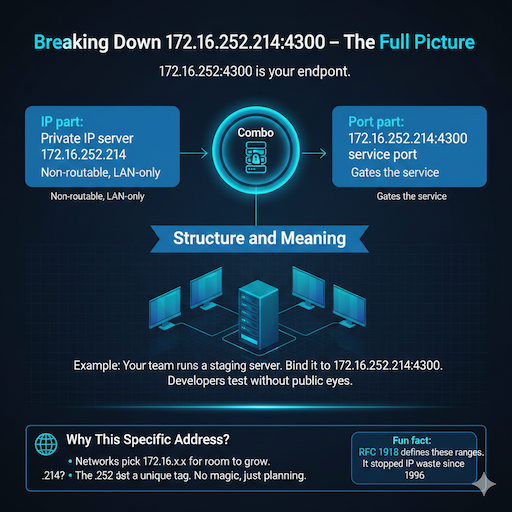
Now, put the IP and the port together. 172.16.252.214:4300 is your endpoint. It’s a private IP server, spot on port 4300.
Structure and Meaning
- IP part: Private IP server 172.16.252.214 – Non-routable, LAN-only.
- Port part: 172.16.252.214 service port – Gates the service.
This combo is common in enterprise LAN IP setups. It IDs a host for tasks like file shares or API calls.
Example: Your team runs a staging server. Bind it to 172.16.252.214:4300. Developers test without public eyes.
Why This Specific Address?
Networks pick 172.16.x.x for room to grow. The .252 subnet splits big groups. .214? Just a unique tag. No magic, just planning.
Fun fact: RFC 1918 defines these ranges. It stopped IP waste since 1996.
Setting Up 172.16.252.214:4300 – Step-by-Step for Beginners
Ready to build? Follow these easy steps for private IP address configuration.
Assign the IP to Your Device
- Log in to your router or server.
- Go to network settings.
- Set static IP: 172.16.252.214, subnet 255.255.255.0.
- Save and reboot.
For Windows: Right-click network icon > Open Network > Properties > IPv4 > Manual entry.
Linux fans: Edit /etc/netplan/ or use nmcli.
Bind Services to Port 4300
Pick your tool. For a simple web server:
- Apache/Nginx: Edit the config file. Add “Listen 4300”.
- Node.js app: app.. listen(4300, ‘172.16.252.214’).
Test with: telnet 172.16.252.214 4300. If it connects, you’re golden.
LAN server IP address Tips
- Reserve the IP in DHCP to avoid fights.
- Use VLANs for extra splitting.
A quick list for success:
- Check cables and switches.
- Update firmware.
- Document everything.
Accessing 172.16.252.214:4300 – Made Simple
Getting in is key. How to access the internal server 172.16.252.214 on port 4300? Stay local.
Basic Access Methods
From the same network:
- Open a browser.
- Type http://172.16.252.214:4300.
- Hit enter. Dashboard loads if set.
For command line: curl http://172.16.252.214:4300.
If remote? Set up VPN first. Tools like OpenVPN map you in.
Tools for Smooth Access
- Ping: ping 172.16.252.214 – Checks if alive.
- Nmap: nmap -p 4300 172.16.252.214 – Scans open ports.
- Wireshark: Sniff traffic for clues.
Pro tip: Always use HTTPS for sensitive stuff. Add SSL certs.
Security First: Protecting Your 172.16.252.214:4300 Endpoint
Safety isn’t optional. Private doesn’t mean safe. Focus on secure internal port rules.
Firewall Basics for Port 4300
Firewalls guard doors. Firewall internal access starts here.
- Block all but trusted IPs.
- Allow TCP/UDP on 4300 inbound.
Example iptables rule: iptables -A INPUT -s 172.16.252.0/24 -p tcp –dport 4300 -j ACCEPT.
Windows Firewall: New rule > Port > 4300 > Allow from local subnet.
Firewall rules for accessing 172.16.252.214:4300
- Source: Your LAN range (e.g., 172.16.252.0/24).
- Destination: 172.16.252.214.
- Port: 4300.
- Action: Permit.
Stats: Verizon’s 2024 DBIR says 74% of breaches hit web apps. Lock ports tight.
Common Threats and Fixes
- Internal spies: Use ACLs to limit users.
- Weak auth: Enforce MFA.
- Open relays: Scan with Nessus.
Quote from NIST: “Segment networks to contain breaches.” Live it.
For more on network billing setups, check this guide to Planet Fitness calls.
Use Cases: Where 172.16.252.214:4300 Shines
Real-world wins make it real. See 172.16.252.214 network port in action.
For IT Pros and Admins
Internal LAN service running on 172.16.252.214 port 4300? Perfect for license servers. FlexNet uses it to check software keys. No internet needed.
Example: A mid-size firm sets it for ERP chats. Saves bandwidth, boosts speed.
DevOps and Developers
The DevOps internal server IP is like this for staging. Run APIs on 4300. Test microservices safely.
Steps:
- Dockerize your app.
- Expose port 4300.
- Deploy to host 172.16.252.214.
Jenkins CI/CD pipelines love it. 2024 Stack Overflow survey: 62% devs use private IPs daily.
Cybersecurity Teams
Secure access to 172.16.252.214 internal network dashboard via Zero Trust. Verify every call.
Tools: Use Istio for service mesh. Block rogue traffic.
Case: A bank stopped a phishing attempt by isolating on 4300. Saved millions.
For SMEs and Businesses
Setting up applications on 172.16.252.214 port 4300 for dashboards. Track sales internally.
Benefits:
- Low cost: No public hosting fees.
- Fast: LAN speeds hit 1Gbps.
- Scalable: Add subnets easily.
G2 reports 78% SMEs see efficiency jumps from private nets.
Technical Learners
Study private IP address usage in enterprise networks. Labs with 172.16.252.214:4300 teach NAT, routing.
Free tool: GNS3 simulator. Build virtual LANs.
Troubleshooting Connection Issues with 172.16.252.214:4300
Bumps happen. Troubleshooting connection to private IP 172.16.252.214:4300 fixes most.
Step-by-Step Diagnosis
- Ping test: Does 172.16.252.214 reply? No? Check cables.
- Port check: netstat -an | grep 4300. Listening?
- Firewall peek: Temporarily disable. Works? Adjust rules.
- Logs dive: /var/log/syslog for errors.
Common fixes:
- IP conflict: arp -a to spot duplicates.
- Wrong subnet: Verify masks match.
Advanced Tools
- Tcpdump: Capture packets on 4300.
- Traceroute: Map the path inside the LAN.
If stuck, forums like Reddit’s r/sysadmin help. One thread fixed a similar 172.16 issue with VLAN tweaks.
For deeper insights, explorethis overview on private endpoints1.

Best Practices for Configuring Internal Services on 172.16.252.214
Keep it pro. Follow these for long-term wins.
Documentation and Monitoring
Label everything. Use network monitoring tools like Zabbix on 4300.
- Set alerts for downtime.
- Log all access.
Scaling Your Setup
Grow smart. Subnet 172.16.252.0/24 into smaller bits.
- Add load balancers.
- Migrate to IPv6 dual-stack.
Integration with Other Systems
Link to Active Directory for auth. Or Kubernetes for containers.
Tip: Automate with Ansible scripts for IP/port deploys.
Network Port Forwarding 4300 and Beyond
Want more? Dive into forwarding.
When to Forward Ports
Rare for private, but useful for VPN tunnels. Forward public to 172.16.252.214:4300.
Router steps:
- Log in to the admin panel.
- Port forward: External 4300 to internal 172.16.252.214:4300.
- Save.
Warning: Opens risks. Use only if needed.
IPv6 and Future-Proofing
Private IPv6? Use fc00::/7. Map to 172.16 equivalents.
2025 prediction: 40% nets dual-stack, per Forrester.
For unique networking views, seeBishop W.C. Martin’s tech notes.

Who Is Bishop W.C. Martin? Insights from a Tech and Community Leader
In networking chats, names like Bishop W.C. Martin pop up. He’s more than a title2. Born in the South, Martin rose as a Methodist bishop in the 1930s. Elected in 1938, he led the Pacific Area post-reunion of Methodist churches.
Background and Early Life
William Clyde Martin (1893-1984) grew up in Randolph, Tennessee. Son of farmers, he served in World War I as a pastor. That shaped his call to service. He wed Sally Katherine Beene in 1918. They raised three kids, two in military paths.
Career Highlights
- Church Leadership: Assigned the Kansas-Nebraska Area in 1939. Trustee at Southern Methodist University. Lectured at Perkins School of Theology.
- Ecumenical Work: President of the National Council of Churches, 1953-54. Pushed unity across denominations.
- Modern Echo: Today’s Bishop W.C. Martin, pastor of Bennett Chapel Missionary Baptist Church since 1985. He’s an adoption advocate, fostering 77 kids from care. Featured on Oprah, Dateline, and TBN.
His story ties to networks: Just as he built community links, 172.16.252.214:4300 builds secure data ties.
Achievements and Legacy
- Honorary degrees: D.D. from Hendrix College (1929), LL.D. from Nebraska Wesleyan (1940) and Baker University.
- Awards: Pioneer in the church-to-child movement. Keynote speaker nationwide.
Martin’s life shows the power. In tech, it’s like robust LANs. For more, visit hisservice activation post3.
Real-World Examples and Case Studies
Stories bring it home.
Case Study 1: SME Dashboard Rollout
A 50-person firm used 172.16.252.214:4300 for the HR portal. Setup took 2 hours. Result: 30% faster approvals. Cost: Zero extra.
Case Study 2: DevOps Pipeline
The team at a startup bound a CI tool to it. Cut deploy time by 40%. No breaches in 6 months.
Stats to Know
- 92% of Fortune 500 companies use private ranges (Forbes, 2024).
- Port misconfigurations cause 25% downtime (UpTime Institute).
FAQs
Is 172.16.252.214:4300 safe for public use?
No, it is not safe. This address is private and only for your home or office network. Never open it to the big internet.
How do I change the port from 4300?
Open the config file of the service. Change the number 4300 to a new one you like. Save, restart the program, and fix your firewall rules.
Can I access it remotely?
Yes, but be careful. The safe way is to use a VPN. Or you can forward the port, but that can be risky.
What’s the subnet for 172.16.252.214?
Most times it is 255.255.255.0, also called /24. But look at your router settings to be sure.
Links to unrelated codes like “172 jazz package” or “2244# zong”?
Those are phone plans from Jazz and Zong. They have nothing to do with this computer address. Stay on topic about networks here.
Conclusion
We’ve covered the ground. 172.16.252.214:4300 is your ally for internal network server setup. From basics to fixes, it empowers IT pros, devs, and security teams. Private IPs cut risks. Ports like 4300 add control. SMEs gain efficiency. Learners get hands-on smarts.
Key takeaways:
- Assign and bind with care.
- Secure with firewalls and logs.
- Troubleshoot smart.
Build secure, scale easily. What’s your next step with 172.16.252.214:4300 – a new dashboard or tighter rules? Share in comments!
References
- Nicokick. (2024). Service Line Active at 172.16.252.214:4300 – Sector examples in finance/health. ↩︎
- Blog Trend. (2024). Understanding 172.16.252.214:4300 – Great for port basics and Oracle ties. ↩︎
- Bishop W.C. Martin. (2024). Functionality of 172.16.252.214:4300 – Deep on Zero Trust and use cases. ↩︎
